Army Successfully Detonates Unstable Lead Azide at Iowa Plant
The U.S. Army detonated nearly five tons of unstable lead azide in Iowa, with officials confirming that containment measures were successful and initial air readings showed no detectable lead.
By Grace Almasi ·
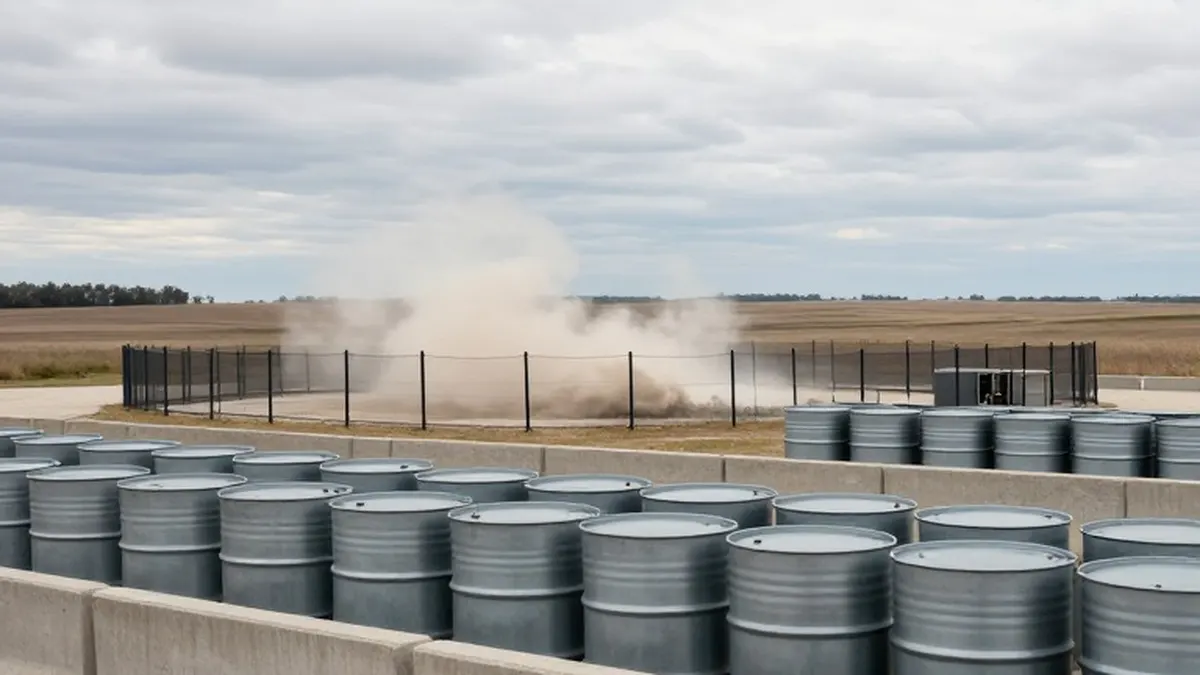
The U.S. Army completed a controlled detonation of nearly five tons of degraded lead azide at its ammunition plant in Middletown, Iowa. The operation, which had faced multiple delays and legal challenges, concluded with two distinct explosions audible in the surrounding area. Federal officials indicated that the blast was well-contained and that mitigation efforts exceeded initial expectations.
President Donald Trump confirmed the success of the operation via a Truth Social post, noting that early reports suggested the mitigation strategies were effective. A senior administration official echoed this sentiment, describing the outcome as a major success. Missouri Governor Mike Kehoe verified that the explosion occurred approximately 15 minutes after it was first heard by residents. Updated Army projections had indicated the blast plume might drift southwest toward the northeastern corner of Missouri.
In a social media statement, Governor Kehoe said that initial analysis from federal partners and Iowa Homeland Security and Emergency Management indicated the explosion was well-contained. Residents and environmental groups had previously expressed concern that the detonation could release toxic lead dust into the community. To address these risks, the Army constructed extensive barriers and applied specialized gels designed to absorb fallout.
As of noon Eastern Time, none of the four live air monitors installed by the Environmental Protection Agency along the expected plume path had detected lead. FEMA Administrator Cameron Hamilton described the atmosphere at the Army command center as one of relief. He stated that the mitigation efforts were very successful and that there did not appear to be a significant lead plume, contrary to some projection models.
FEMA has advised residents within a 20-mile radius of the blast site who have not evacuated to continue sheltering in place and to follow EPA safety guidance. In the coming days and weeks, federal agencies will collect air and soil samples. Additionally, Department of Agriculture officials are scheduled to visit nearby farms to conduct impact assessments.
Rob Sand, the Democratic governor-elect of Iowa, agreed that lead dispersal appears limited. He thanked the personnel on the ground for ensuring the detonation was as safe as possible. However, Sand noted that the lead-up to the event was chaotic and unclear. He urged for immediate transparency regarding how the situation developed and emphasized that affected Iowans must be taken care of fully and right away.
Army and federal officials had determined that a controlled detonation was safer than allowing a spontaneous explosion. The material, known as lead azide, is highly volatile. The substance had crystallized, making it extremely sensitive to heat, shock, and friction. Officials warned that freezing temperatures, such as those recorded in Middletown on Wednesday, could further destabilize the material and trigger an uncontrolled blast.
The lead azide was transported to the Middletown munitions plant in 2009, according to ATF Director Robert Cekada. Acting Army Secretary Adam Telle stated that the material was discovered to be crystallizing during a routine inspection in March. The Army initially considered chemical neutralization, thermal treatment, or relocation. However, opening the unstable barrels to add chemicals posed a risk of immediate explosion, leading to the decision for a controlled detonation.
On November 13, the EPA granted an emergency permit for the detonation, valid through February 11, 2027. The Army originally set the date for November 20. The Iowa Environmental Council and the Iowa chapter of the Sierra Club subsequently sued the EPA, halting the plans. President Trump ordered the Army not to proceed without court approval. The Eighth Circuit Court of Appeals lifted the stay on Monday, allowing the detonation to take place.
More News · National news · Report a business · Got a Story?