Central Arizona Project faces 47% cut after 1960s engineers predicted shortfall
New federal water plans threaten to slash the canal's supply, validating warnings from its original architects that were ignored for decades.
By Amit Chukwu ·
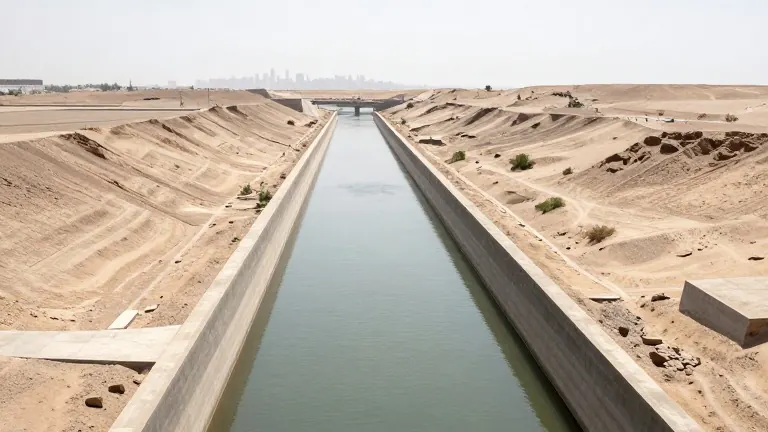
A 47% reduction in water allocation now looms over the Central Arizona Project, the massive infrastructure system that supplies the Phoenix area. This potential cut stems from a new federal plan designed to manage the Colorado River's declining flows. The plan has triggered legal action from Arizona, Nevada, and the canal operators themselves.
The 336-mile network of canals, pipelines, and pumping plants is essential to the region's existence. Rich Weissinger, who worked as director of field maintenance for the system for nearly 30 years, called it an engineering marvel. Inside the pumping plants, large motors and turbines operate within heavy metal casings to keep water moving. Weissinger noted that many municipalities and industries rely on the system for a stable water source.
However, record droughts and climate change have strained the river's capacity. Policymakers across the seven states that use the Colorado River have failed to agree on a regionwide compromise to rein in demand. As a result, the two largest reservoirs in the nation have shrunk to record lows. The new federal plan aims to address this deficit by cutting water use, with Arizona facing some of the steepest reductions.
The crisis was not a surprise to the system's original designers. In the 1960s, the architects of the Central Arizona Project issued explicit warnings about future water scarcity. They predicted that available supplies would drop significantly in the 21st century. To counter this, they proposed augmentation, which would involve adding outside water supplies to the river system.
Floyd Dominy, then commissioner of the Bureau of Reclamation, forecasted that water available for the project could be halved between 1990 and 2030. He attributed the decline to growing use in upstream states such as Colorado, Utah, and Wyoming. While drought was not the primary factor in his 1960s model, his prediction that less water would reach Phoenix and Tucson proved broadly correct.
Congressman Mo Udall of Arizona also advocated for additional water sources during the project's authorization. In 1968 testimony, he stated that he was certain augmentation would occur. He suggested connecting the Colorado River system to the Columbia River in the Pacific Northwest or building massive desalination facilities on the Pacific Coast. Senators from the Pacific Northwest even added a clause to the legislation barring federal studies of such a connection for ten years to protect the Columbia River.
Those suggestions never became reality. Tom McCann, a former deputy general manager for the Central Arizona Project, said there was no willingness to spend money on a future problem that had not yet arrived. He noted that the warning was largely forgotten over the decades. While managers continued to study augmentation options, cost and political hurdles prevented implementation.
Brad Udall, son of Mo Udall and a senior water research scientist at Colorado State University, believes the original proponents underestimated the difficulty of the proposed fixes. He said his father and uncle could have done better than suggesting complicated, expensive measures. However, he offered context for their approach, noting that the 1960s was an era of national optimism and engineering confidence.
"The 1968 idea was we could build our way out of anything," Brad Udall said. "We could engineer our way out of every crisis." He added that the group likely wanted to finish the massive project quickly after a long legal battle with California. They assumed they could address the hard problems later.
Chuck Podolak, former director of the Water Infrastructure Finance Authority of Arizona, offered another perspective on the 1960s strategy. He suggested that promising augmentation allowed policymakers to avoid acknowledging that urban growth would come at the expense of agriculture. Farms and ranches currently account for roughly three quarters of all Colorado River water use. Podolak argued that buying water from farmers would have been more affordable than building new infrastructure, but the promise of augmentation provided a political escape route.
More Business · Customer Complaints · Report a business · Got a Story?