
New research quantifies warming impact of drained peatlands
A study led by MIT researchers estimates that historical drainage of peatlands has contributed significantly to global warming by shifting emissions from methane to carbon dioxide.
By Grace Almasi ·
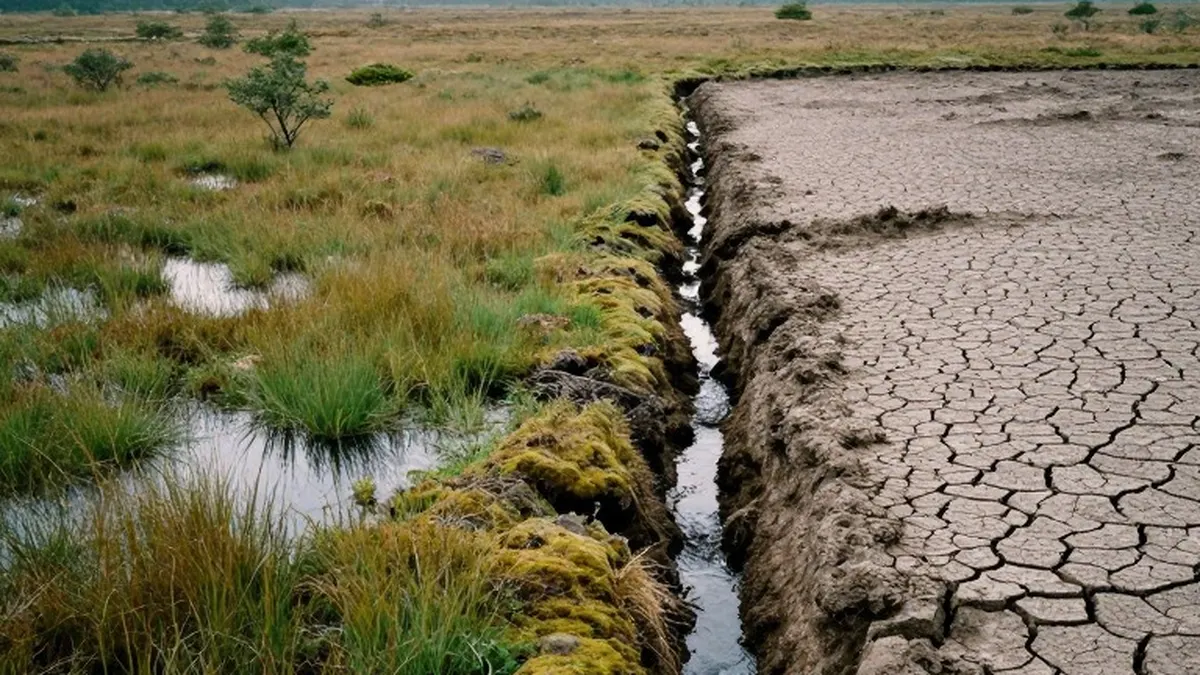
While public attention on climate change often centers on the burning of fossil fuels, alterations to land use represent a substantial portion of the issue. These changes account for approximately one-third of all carbon dioxide emissions released throughout history. Although deforestation is frequently cited as the primary driver, other practices such as the draining of wetlands also play a significant role in the global carbon cycle.
Determining the precise contribution of wetland loss to global warming has historically been difficult. However, new data sources that measure emissions from currently surviving wetlands have allowed scientists to refine their estimates. A recent study led by Jevan Yu at the Massachusetts Institute of Technology focuses specifically on peatlands, which include environments such as bogs and fens where organic matter accumulates over time into thick layers.
According to the researchers, these vast peat stores hold approximately 600 billion tons of carbon. This amount exceeds the total carbon found in all living vegetation on Earth. Under natural conditions, these areas are permanently flooded. The oxygen present in the water is rapidly consumed, leaving anaerobic bacteria to handle the decomposition of organic matter. These bacteria work much more slowly and do not fully digest the material.
In undisturbed peatlands, most organic carbon is kept out of the atmosphere. Instead of converting entirely into carbon dioxide via aerobic bacteria, a portion of the carbon gradually transforms into methane. Methane is a more potent greenhouse gas than carbon dioxide and eventually oxidizes into carbon dioxide. This process creates a specific trade-off where the majority of stored carbon remains sequestered, while the carbon that does escape primarily does so in the form of methane.
Human activity has disrupted this balance. Many peatlands have been drained by digging ditches to allow water to flow out, often to repurpose the land for agriculture or other uses. Lowering the water table exposes the peat to air, supplying oxygen to the material. This change favors aerobic bacteria, which rapidly break down the organic matter.
As a result of this exposure, methane emissions decrease while carbon dioxide emissions increase significantly. To quantify this shift, the research team utilized recent studies measuring gas emissions from peatlands to build a global model. This model estimated the release of both carbon dioxide and methane as water levels dropped.
The study notes that the two gases respond differently to changes in water levels. Specifically, carbon dioxide emissions vary depending on the geographic location of the bog. By reconstructing historical water-level changes caused by peatland drainage, the team simulated the effects of these changes starting from the year 1800.
This approach allows for a more accurate assessment of how historical drainage practices have influenced the global carbon budget. The findings highlight that while peatlands are critical carbon sinks, their management and preservation are essential for mitigating climate change.
The research underscores the importance of considering land use changes alongside fossil fuel emissions when addressing global warming. By understanding the specific mechanisms of carbon release in drained peatlands, policymakers and scientists can better evaluate strategies for restoring these vital ecosystems.
The study provides a clearer picture of the historical contribution of peatland drainage to atmospheric greenhouse gas concentrations. As efforts to combat climate change continue, the role of land-based carbon stores will likely become an increasingly central topic in environmental discussions and policy decisions.
More News · National news · Report a business · Got a Story?