European Pesticide Brands Named in More Than 1,600 Poisoning Reports in Brazil
An investigation found that brands sold by European chemical companies appeared in 1,605 Brazilian pesticide poisoning reports last year, with about a third involving chemicals banned for farm use in the EU.
By Grace Almasi ·
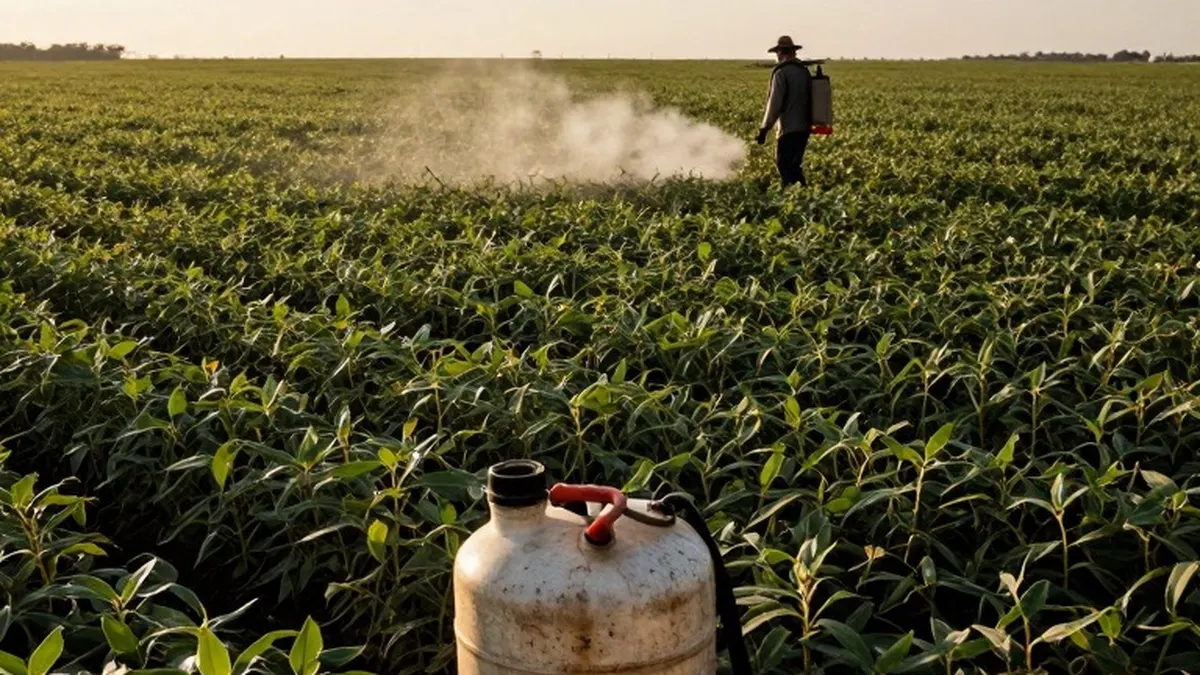
Pesticides sold by European chemical companies appeared in more than 1,600 poisoning reports in Brazil last year, according to an investigation published on Tuesday by Unearthed and Public Eye. Roughly a third of the cases involved chemicals that cannot legally be sprayed on European farms because of the dangers they pose to people and the environment, yet manufacturers remain free to produce them for export to countries where they are permitted.
The analysis of Brazilian health ministry data found that of 2,857 poisoning reports naming an identifiable agricultural product, 1,605 cited brands sold by European pesticide makers. In total, more than 6,700 medical reports involving agricultural pesticides were filed last year. Among the reports that named a product, 1,420 were classified as confirmed poisonings and 1,108 as exposures, with the rest recorded as unknown or other diagnoses.
Under Brazilian law, healthcare professionals must report all suspected pesticide poisonings to the national disease notification system, but laboratory confirmation is rare and diagnoses usually rest on clinical judgment. Experts say a named brand is not proof it caused harm, and clinicians often lack training to confirm cases. "The insufficient training of healthcare professionals to recognise and manage these cases is a major limiting factor," said Vanda Garibotti, a public health biologist at the State Centre for Health Surveillance in Rio Grande do Sul, adding that high staff turnover and weak institutional support compounded the problem.
Among the products identified is Reglone, a weedkiller made by Swiss-headquartered Syngenta at a factory in Huddersfield, England. It contains diquat, banned on EU farms since 2019 and in the UK since 2020 after experts found it posed a high risk to workers, nearby residents and birds. The health ministry recorded 75 diquat cases last year, up from 36 across the five years from 2018 to 2022, and Reglone was specifically named in 44 reports, including four deaths.
One of those who died was Nelson Castoldi, a farmer in Rio Grande do Sul. His family had bought Reglone in bulk and poured a litre into an empty cola bottle to avoid carrying a heavy 20-litre canister into the fields. Working under scorching sun, Castoldi mistook the black liquid for a soft drink and sipped it. Although he spat it out at once, the chemical shut down his kidneys and then attacked his lungs, killing him two days later. "We fell apart," his son Ivan Castoldi said, adding that his mother died four months later. "That poison, Reglone, should be banned in Brazil. Not because of what happened to us, but because of its toxicity."
Another product, Dormex, is manufactured in Germany by Alzchem and distributed in Brazil by BASF. It contains cyanamide, banned in the EU in 2008 over health concerns for farm workers. Sidnei Souza de Oliveira, 49, said a jug of Dormex spilled on his leg when a handle broke as he filled a sprayer. He kept working for four days before seeking hospital care. "After 15 days, my leg was black. Chunks of flesh were falling off," he said, and a doctor had to cut away dead tissue to stop the injury spreading towards the bone. The database recorded 17 confirmed Dormex poisonings last year.
Finale, a BASF product containing glufosinate, which was banned in the EU in 2018 and is classified there as toxic to reproduction, was also identified. Roundup, Bayer's glyphosate-based weedkiller, was frequently cited in reports, including 12 deaths. Across all reports involving European companies' products, there were 32 reported deaths, 31 of them confirmed poisonings and 26 recorded as suicides. Syngenta products were cited 425 times and BASF products 179 times, with some reports naming more than one manufacturer. Nina Schrank of Greenpeace UK called the findings a "deadly double standard", saying: "If a pesticide is too dangerous to use in Britain, it should be too dangerous to export."
Syngenta said almost half the Brazilian cases attributed to it were not confirmed poisonings and accused the investigation of disregarding the dataset's final classifications, saying the evidence risked being "selectively interpreted to support a predetermined conclusion". The company added: "There are real people behind these statistics. Every genuine case of poisoning matters, and every family affected deserves our concern." It said Brazil has its own robust regulatory system and that it trained 95,000 people there in safe product use in 2025.
Bayer said its products are safe when used according to label instructions and questioned the reliability of the data, noting that exposures had not been independently verified and that "Roundup" is often used as a generic term that could cover other manufacturers' or counterfeit products. BASF said it was deeply concerned by any poisonings potentially linked to its products, while noting some incidents may have involved intentional ingestion, which it described as deliberate misuse. Both companies pointed to training programmes, with Bayer saying its efforts reached more than 4 million people globally in 2025 and BASF reporting more than 14,475 participants in Brazil.