Coordinated settler attacks intensify in West Bank villages near Ramallah
Coordinated settler attacks involving vehicle arson and land seizures have intensified in villages near Ramallah, coinciding with the annual olive harvest season.
By Renata Mehta ·
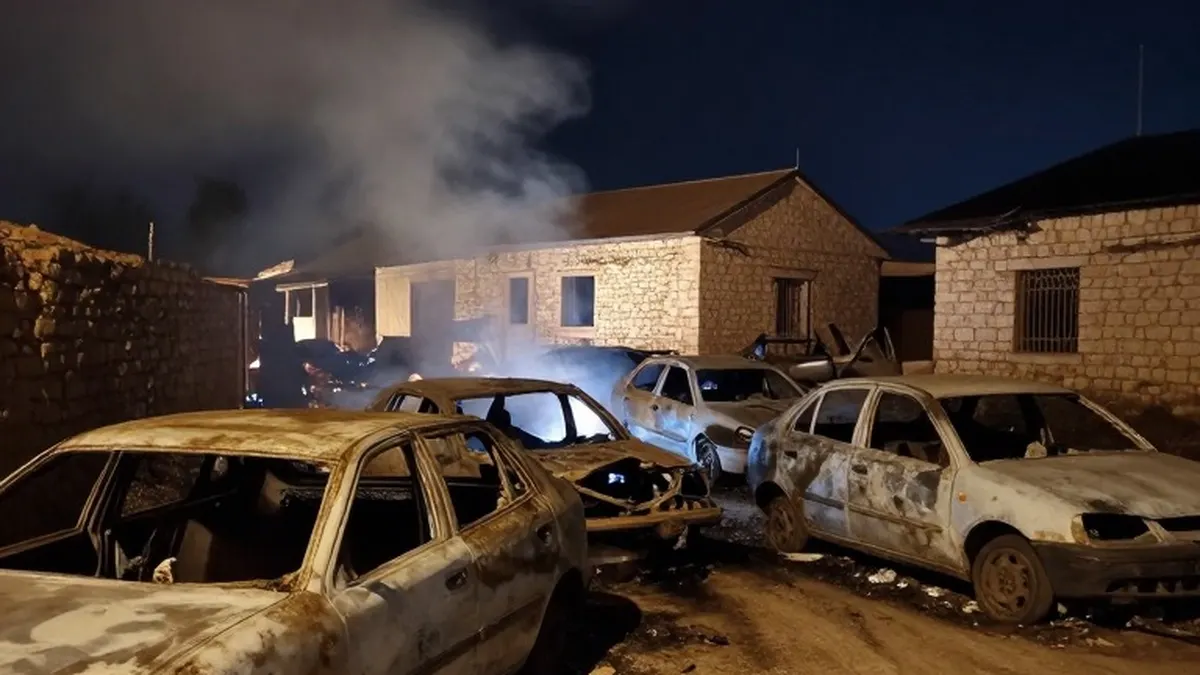
A series of coordinated incidents by Israeli settlers has targeted several Palestinian villages in the central occupied West Bank over the past two days. Between Saturday evening and Sunday morning, vehicles were torched in three distinct locations near the city of Ramallah. The attacks were accompanied by racist slogans spray-painted on residential walls, creating a sense of urgency and fear among local residents.
In the village of Deir al-Sudan, north of Ramallah, village council head Rafat Abu Musa reported that settlers infiltrated the southern part of the community at 11:30 p.m. on Saturday. They burned two vehicles and marked nearby homes with Hebrew slogans calling for revenge against Arabs. Abu Musa noted that this specific area had been targeted by a similar vehicle fire just two months prior.
Abu Musa stated that the attackers came from a newly established outpost on the summit of Jabal al-Ras in the neighboring village of Umm Safa. He criticized the response time of emergency services, noting that the fire department required coordination with the Israeli army. By the time crews arrived, the vehicles had already been reduced to ashes. According to Abu Musa, settlers seized a significant portion of the southern mountain five months ago, building roads and establishing the outpost, which now blocks access to more than half of the village's olive trees.
The area where these vehicles were torched is classified as Area A. Under the Oslo Accords, this zone is supposed to be under exclusive Palestinian control. Abu Musa described the recent surge in violence as systematic, stating that it is being directed by extremist Israeli ministers.
Hours after the incident in Deir al-Sudan, a similar attack occurred in the town of Kafr Malik, east of Ramallah. More than ten settlers infiltrated the northern part of the town, arriving from an outpost located between Kafr Malik and al-Mughayyir. Resident Jihad Qaq explained that the group had to trek for at least an hour along a rugged mountain path to reach the village. They set fire to seven vehicles and wrote slogans on house walls before withdrawing.
Qaq described the aftermath, saying that the Israeli army stormed the town one hour after the attack. They forced civil defence crews, who were in the process of extinguishing the fires, to leave and drove away the residents. Although the army conducted an investigation, Qaq said they withdrew without any results. He noted that the village faces constant harassment, referencing an incident a year and a half ago where settlers killed three young men. This year, settler herders have prevented more than 70 percent of olive harvesters from reaching their land.
In the western village of Deir Abu Mashal, classified as Area B, settlers burned eight vehicles and painted slogans in the eastern part of the community. Village council head Jamil Musa said the group of eight to 10 individuals arrived at 2:30 a.m. from an outpost established a few months ago. The Israeli army raided the village and promised an investigation, but Musa stated that nothing has come of it and police have yet to follow up. Residents in this village are currently unable to access nearly half of their land for the olive harvest due to frequent assaults.
Data from the Commission Against the Wall and Settlements indicates a marked increase in settler attacks during October, coinciding with the olive harvest season. The group recorded 1,369 attacks in October, representing a 112 percent rise compared to the 647 incidents seen in September.
The United Nations Office for the Coordination of Humanitarian Affairs documented 467 settler attacks resulting in injuries or property damage in October alone. This is the highest monthly figure since the organization began tracking such incidents in 2006. From January through 19 October, Ocha recorded a total of 2,159 attacks, averaging 7.4 incidents per day. This is a significant increase from the daily average of five attacks recorded throughout 2025.
The violence has been particularly concentrated during the harvest period. Between 1 September and 19 October, 272 attacks linked to the olive harvest were recorded. These incidents resulted in the killing of one Palestinian, injuries to 200 others, and the destruction of more than 3,200 olive trees.