Gold Prices Plunge Below $3,800 as Currency Factors Override Safe Haven Demand
Gold has fallen below $3,800 as rising interest rates and a stronger dollar increase the opportunity cost of holding the non-yielding asset.
By Grace Almasi ·
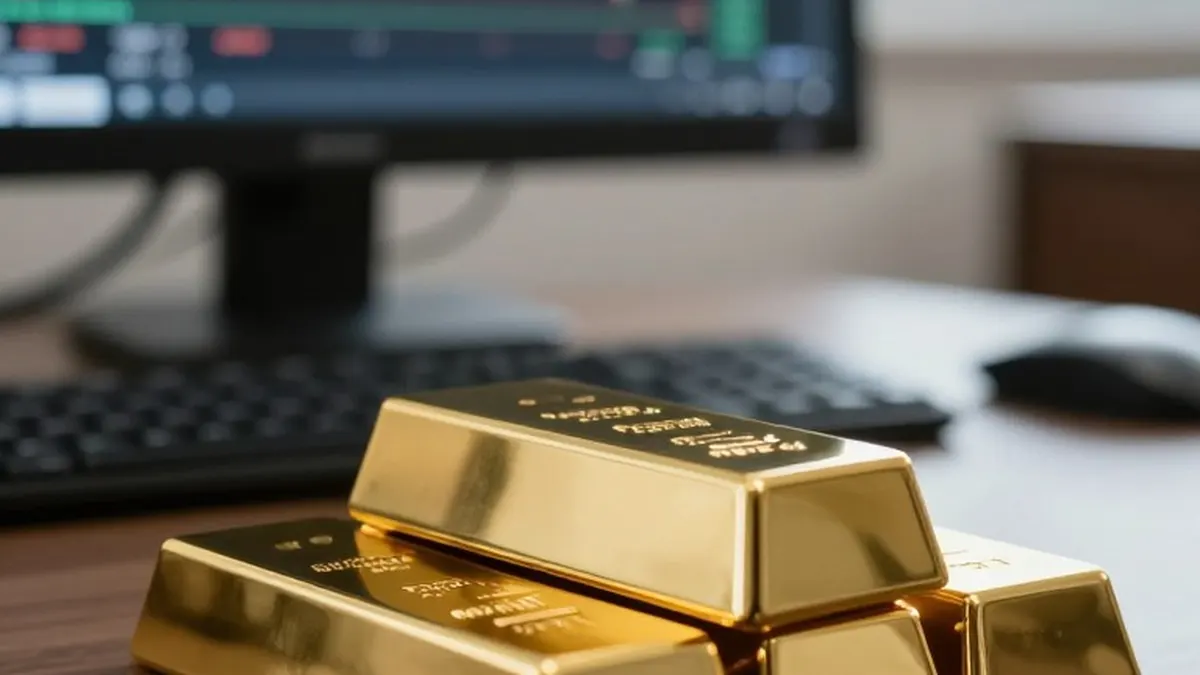
Investors in precious metals are experiencing significant volatility as gold prices continue their steep decline. After reaching a historic peak of $5,589.38 per ounce on January 28, the metal has fallen below $3,800 for the first time since September 2025. This drop represents a reduction of roughly one-third from its early year high, marking a sharp reversal after gold set 53 new records during 2025.
Suki Cooper, global head of commodities research at Standard Chartered, explained that the initial surge was driven by strong physical demand and a shift in portfolio strategies. As the cost of holding non-yielding assets decreased, long-term investors increased their exposure. Consequently, holdings in gold-backed exchange-traded funds, led by the SPDR Gold Shares, rose by approximately 800 tons in 2025. According to the World Gold Council, global gold ETFs recorded their strongest year for inflows, totaling $89 billion, with assets more than doubling to $559 billion.
The momentum was further supported by a weakening dollar, lower bond yields, and concerns over global debt levels. Evan Mills, a financial advisor with Scholar Financial Advising, noted that these factors made gold an attractive alternative to cash, which typically loses purchasing power in low-interest-rate environments. However, the rapid pace of the rally eventually raised concerns among investors, particularly as the Federal Reserve began signaling a potential shift toward tighter monetary policy.
The dynamic changed significantly following a conflict in the Middle East. Cooper observed that gold ceased to function primarily as a safe haven and instead acted as a liquidity provider. Because the metal is highly liquid, investors sold their holdings to raise cash, triggering the first major correction. Since then, market sentiment has been heavily influenced by expectations of Federal Reserve actions, with the central bank leaning toward higher interest rates in 2026.
Christopher Waller, a member of the Federal Reserve Board of Governors, recently suggested that a 50-basis point rate hike might be necessary to influence market behavior. Mills pointed out that rising Treasury yields and a strengthening dollar have increased the opportunity cost of holding gold, an asset that does not generate income. In the current environment, cash held in money market funds offering 4% to 5% interest has become a more compelling option for preserving purchasing power.
This shift has made traditional portfolio components, such as stocks and bonds, more attractive relative to gold. Mills emphasized that the scarcity of gold has not changed, but the alternatives to owning it have improved. Similar trends have affected other metals, with silver also falling from its all-time high. Experts advise investors to remain cautious in the short term, as real yields rise and the dollar strengthens. Mills suggested that gold is best viewed as insurance rather than a growth engine, and buying it after a sharp price increase may not be the optimal strategy.
Despite the recent downturn, some analysts maintain a positive long-term outlook. Amy Gower, head of metals and mining strategy at Morgan Stanley, stated that there are still many reasons for investors to hold gold. Philip Diehl, president of U.S. Money Reserve, compared the recent volatility to a black swan event caused by geopolitical shifts and trade policy changes. He expects gold to resume its upward trajectory in 2027 as oil prices normalize and interest rates stabilize following recent political decisions to end the conflict.
Central banks continue to be a source of demand, with September marking the highest monthly total for purchases according to the World Gold Council. However, overall buying is 7% lower than in the same period last year. Marc Chandler, chief market strategist at Bannockburn Capital Markets, noted that while retail investors have faced losses, central bank support remains a key factor. He cautioned that gold is still expensive compared to historical averages, with the 10-year moving average at $2,127 and the 20-year average at $1,666.
Chandler predicts that gold prices may fall further to the $3,500 to $3,600 range. He urged investors who are looking for a bottom to exercise patience and wait for clear reversal patterns. Although the decline appears orderly, the current price levels are well above the long-term moving averages, suggesting that the metal may still have room to adjust before stabilizing.
For now, the market is watching for signs of stabilization as investors weigh the benefits of holding a non-yielding asset against the appeal of interest-bearing cash and other traditional investments. The coming months will likely determine whether gold can recover its footing or if the current correction marks a more significant shift in its value proposition.
More News · National news · Report a business · Got a Story?