NTSB reports helicopter flew dangerously low before Biscayne Bay crash
The National Transportation Safety Board determined that a helicopter crashed into the water because it was flying extremely close to the surface during a turn.
By Renata Mehta ·
The National Transportation Safety Board released a preliminary report on Wednesday stating that a helicopter crashed into Biscayne Bay earlier this month because it was flying at an extremely low altitude. The investigation found that the aircraft struck the water surface while executing a turn, which led to the fatal accident.
The incident occurred on November 4 near Bill Baggs State Park off the coast of Key Biscayne. The Miami-Dade Sheriff’s Office confirmed that the Robinson R44 II helicopter was on a mission to film a powerboating event offshore when it went down. The pilot lost his life in the crash, while two other passengers, a photographer and a videographer, sustained critical injuries.
According to the safety board's findings, the helicopter was making low-altitude maneuvers that brought it extremely close to the water. To facilitate better photography and videography, some of the helicopter's doors had been removed prior to the flight. During one of these turns, the rotor blades made contact with the water, causing the aircraft to crash.
The photographer provided a detailed account of the moments leading up to the accident. He told investigators that the helicopter flew low and parallel to the right side of the boat. The pilot then turned and moved ahead of the vessel to capture a good shot as the boat passed underneath the aircraft. Immediately after this maneuver, the videographer observed the rotor blades strike the water surface.
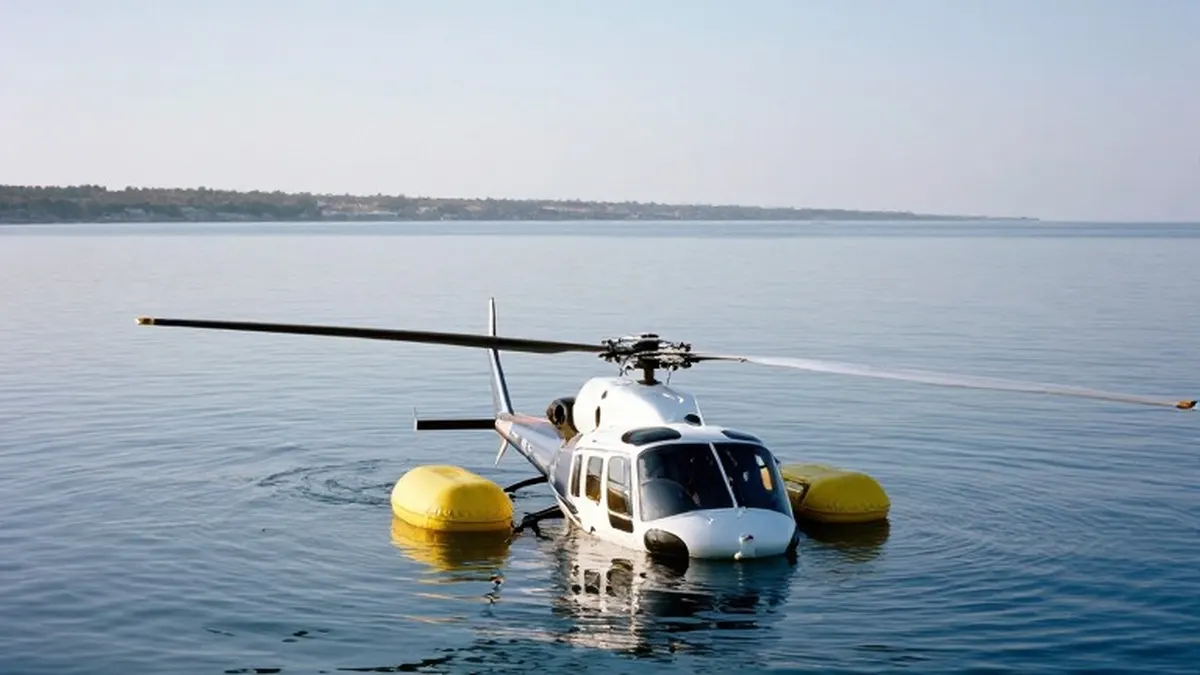
Television news footage of the crash showed the helicopter resting upside down underwater. Two yellow emergency floats attached to the bottom of the landing skids were visible in the video. These floats are specifically designed to help keep a helicopter afloat in the event of a water landing, but they were not enough to prevent the aircraft from sinking.
Witnesses in nearby boats quickly made distress calls after seeing the crash. Sheriff Rosie Cordero-Stutz noted that a good Samaritan also attempted to assist one of the victims before professional help arrived. Rescue workers from several local agencies rushed to the scene to aid the survivors.
The response to the crash was a coordinated effort involving multiple entities. In addition to local rescue teams, the U.S. Coast Guard and U.S. Customs and Border Protection units responded to the area to assist with the recovery and rescue operations. The incident highlights the risks associated with low-altitude aerial filming over bodies of water.
The preliminary report underscores the critical importance of maintaining adequate clearance from the water surface during aerial maneuvers. The removal of doors for photography purposes, combined with the low flight path, contributed to the conditions that led to the rotor blades striking the water. The NTSB will continue its investigation to determine the full scope of the accident.
The crash has drawn attention to the protocols used for aerial filming of water sports events. The pilot's decision to maneuver the helicopter in such a low altitude to get a specific angle resulted in the fatal accident. The injured passengers are expected to recover, though their injuries were described as critical by officials.
This incident serves as a reminder of the dangers involved in close-proximity aerial work. The combination of low altitude, rapid maneuvers, and the proximity to the water surface created a hazardous situation. The findings from the NTSB will likely inform future safety guidelines for similar operations in the region.
More News · National news · Report a business · Got a Story?