The Relativity of Time in 2026 College Football
Coaches and officials are grappling with the unpredictable nature of clock management as recent games feature bizarre timekeeping anomalies and high-pressure finishes.
By Grace Almasi ·
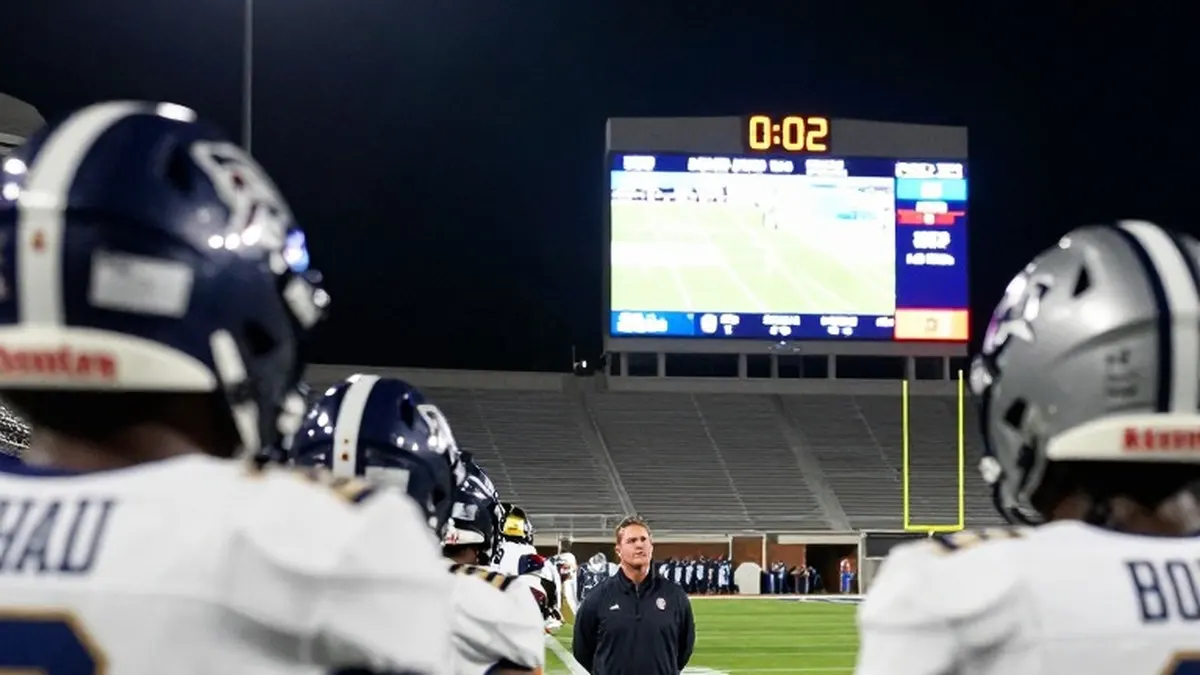
The 2026 college football season has been defined by chaos, with top-ranked teams suffering unexpected losses and new contenders emerging in the College Football Playoff race. However, the most striking aspect of this irregular year is the unpredictability of game finishes. With only two weeks remaining in the regular season, the ability to seemingly bend the rules of time has become a defining characteristic of the sport.
Recent weeks have featured a series of improbable outcomes that defy conventional logic. NC State lost to Vanderbilt despite holding a three-point lead and possession of the ball with six seconds left. In a separate incident, Western Kentucky scored two touchdowns in just two seconds to defeat Jacksonville State. These events occurred on the same night Arch Manning extended the final six seconds to secure a win for his team over LSU at Death Valley. Other notable moments include Iowa’s clock-expiring touchdown pass against Michigan and Notre Dame’s final second disappearing at BYU.
The concept of time in these games feels relative, depending on which side of the scoreboard one occupies. Missouri head coach Eliah Drinkwitz noted that while the physical minutes remain constant, the perceived duration changes dramatically based on a team’s position and the line of scrimmage. This phenomenon is not merely a feeling but a mechanical reality driven by the complexity of modern timekeeping systems.
The confusion was highlighted in Week 1 when Western Michigan appeared to win a historic upset over Michigan on an incomplete pass. Officials in the Big Ten’s replay command center later ruled that one second remained, allowing Michigan to complete a heave for a 13-12 victory. The Big Ten acknowledged the error, but the game stood. This incident revealed that college football relies on multiple clocks rather than a single master timepiece.
Typically, the stadium scoreboard acts as the master clock, synced with the television production truck and the conference replay center 90 minutes before kickoff. On-field officials also monitor time, though they no longer keep backup clocks on their wrists. The primary control is managed from the press box by an official who takes cues from the referee, the game’s ultimate timekeeper. In the Michigan game, a newer sync system implemented by the Big Ten drifted slightly over the course of the game, causing the replay center clock to lag by one second.
To combat these issues, coaches emphasize situational preparation. Vanderbilt head coach Clark Lea stated that while such finishes are unavoidable, teams must practice situational football to be ready. This training involves extensive repetition of late-game scenarios. Nick Saban, widely considered the expert in this area, was known for running two-minute drills daily, preparing his teams for specific high-pressure moments.
Former Alabama player Isaiah Bond recalled how Saban’s team practiced a specific play, dubbed Gravedigger, which resulted in a victory over Auburn. Saban believed that training the mind to slow down moments is as important as training the body. This philosophy has influenced many current coaches, including Kirby Smart, who carries a personal situational sheet to the sideline to guide decisions in the final seconds.
The introduction of the two-minute timeout in 2024 has further emphasized the importance of these strategies. Unlike the NFL’s two-minute warning, this timeout serves as a reset for new clock rules, such as the non-stopping of the clock on made first downs until the final two minutes. Coaches use this break to align with officials on when the clock will start and stop.
Georgia quarterback Gunner Stockton highlighted the mental challenge of managing these details during fast-paced play. He frequently asks for reminders about clock status, noting that the fear of missing a detail can be a strong motivator. As the season progresses, the focus remains on how teams navigate these temporal complexities to secure victories.
More News · National news · Report a business · Got a Story?