Russia begins using Rassvet satellite network for military operations in Ukraine
Russia has started deploying its Rassvet satellite system for battlefield communications and attacks over Ukraine, although its coverage and production capacity remain limited.
By Renata Mehta ·
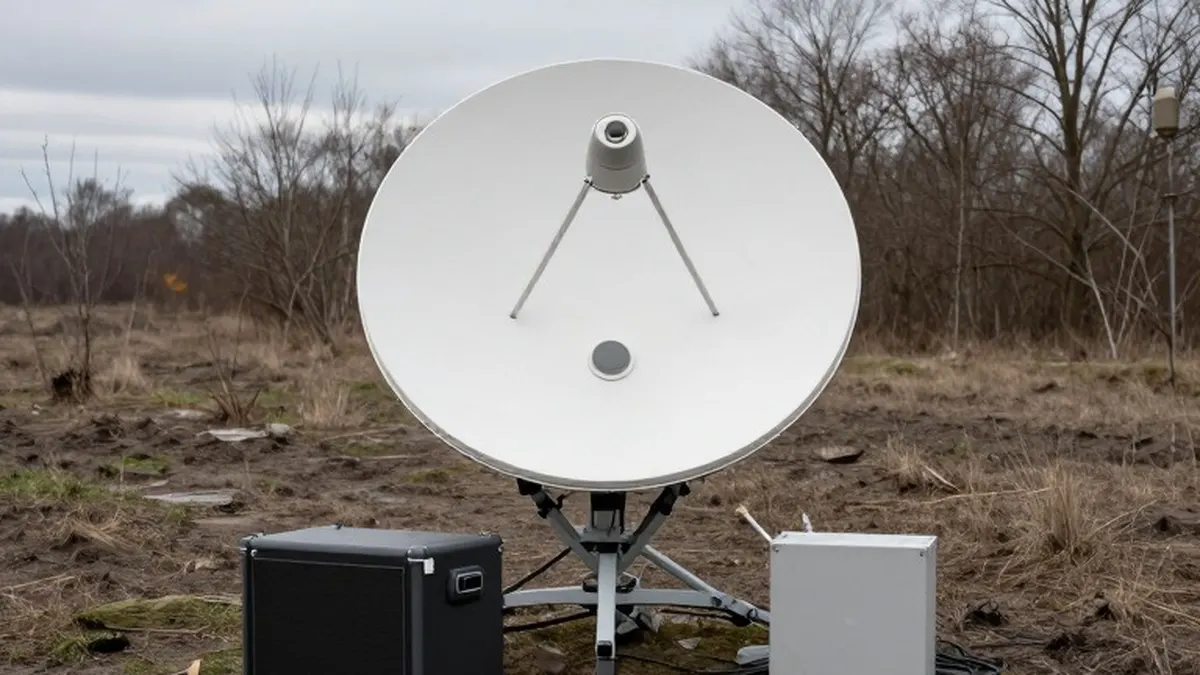
Russia has begun using its Rassvet satellite network for military communications over Ukraine and to conduct attacks, according to information from Ukrainian military intelligence published by Reuters in early November. The service, developed by Russian aerospace company Bureau 1440, operates in low Earth orbit and is widely described by Russian and international media as Russia's counterpart to SpaceX's Starlink.
Ukrainian military intelligence, known as HUR, said Rassvet was being used to improve strike accuracy, extend reconnaissance drone capabilities and increase resistance to electronic warfare. Its spokesperson, Andriy Yusov, told Reuters that the existing constellation could not yet maintain continuous coverage of Ukrainian territory. The first two launches of serial Rassvet satellites took place in March and July 2026.
Interest in the Russian system increased after Russian forces lost access to Starlink, which had supported internet connections and battlefield communications in Ukraine. Although Russia is outside Starlink's service area, its military obtained unauthorized terminals through third countries. Those devices allowed Russian troops to use the same network as Ukrainian forces, including for communications and receiving camera images from drones.
Early in 2026, SpaceX and Ukraine's Defense Ministry introduced a registration system for terminals authorized to operate in Ukraine, disabling devices used by Russian forces. Reports of major communications difficulties subsequently appeared on Russian social media channels. Bloomberg reported in May that Ukrainian forces had regained about 400 square kilometers of territory since Russian troops lost access.
Rocket analyst Georgiy Trishkin, who runs the Telegram channel Tekhassky Vestnik, told DW that Russia intends to establish an operational domestic alternative with 292 satellites by the end of 2027. Serhii Beskrestnov, an adviser to Ukraine's president also known as Flash, warned on Facebook that Rassvet's principal danger was its potential to let Russian forces control drones over Ukraine. He noted that Ukrainian troops cannot use Starlink to control drones over Russia because the service does not operate there.
Bureau 1440 presented initial terminal models in October, as the Russian military seeks to equip drones with satellite connections for operations farther into Ukrainian territory. Trishkin said the two networks shared an overall concept but differed substantially in their technology. Starlink had more than 10,000 satellites, he noted, while Rassvet's initial phase would contain no more than 300.
Production also presents a challenge. According to Trishkin, SpaceX can manufacture around 15,000 ground kits daily, a volume that would represent a significant annual achievement for Bureau 1440. He said the Russian terminals cost considerably more because they depend on foreign components. However, DW's sources said Rassvet was probably conceived for battlefield communications, requiring fewer satellites than Starlink's primarily civilian service. Ukrainian military expert Oleh Starikov said continued development could enable it to meet Russian military requirements.
Meanwhile, satellite service restrictions have again drawn attention in Ukraine. In mid-November, President Volodymyr Zelenskyy reported substantial disruptions to Starshield, SpaceX's service oriented toward government and military users, across the front and occupied Ukrainian territory. He said restrictions applied at speeds of 161 kilometers per hour or above. Restrictions on Starlink use had first been introduced on October 14 and were lifted on October 23, according to US President Donald Trump.