Slovakia Protesters Demand End to Fico Government on Velvet Revolution Anniversary
25,000 demonstrators gathered in Bratislava to challenge the Prime Minister's renewed economic ties with Russia.
By Renata Mehta ·
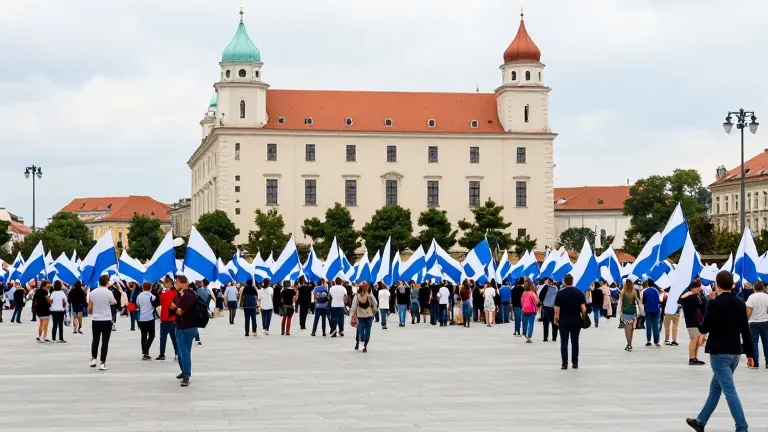
Demonstrators in Bratislava chanted for Prime Minister Robert Fico to leave office on Tuesday, marking the 37th anniversary of the 1989 Velvet Revolution that ended communist rule in Czechoslovakia. Organizers estimated that 25,000 people filled the downtown SNP square to voice their dissatisfaction with the current administration.
The protest brought together a diverse political coalition, including the liberal groups Progressive Slovakia and the Democrats, the pro-business Freedom and Solidarity party, the conservative Christian Democrats, and an alliance representing ethnic Hungarians. These parties plan to coordinate their efforts to defeat Fico’s coalition in the parliamentary election scheduled for next year.
Michal Šimečka, the leader of the major opposition party Progressive Slovakia, addressed the crowd to emphasize unity. "Just as in 1989, what unites us must be stronger than what divides us," he said. "We’ll win only if we stick together."
Tensions escalated recently after the government sent Foreign Minister Juraj Blanár to Russia for talks. The visit marked the first time the two countries have discussed renewing economic cooperation since Russia launched its full-scale invasion of Ukraine in 2022. Fico agreed to the plan during a prior trip to Moscow to meet with Russian President Vladimir Putin.
The Cabinet met just hours before Tuesday’s rally to review a report on Blanár’s visit. In the square, protesters reacted to the diplomatic move with chants of "Shame, shame" and held a banner that read, "Go to hell," directed at the Prime Minister.
Fico’s policies have placed Slovakia at odds with much of Europe regarding the war in Ukraine. He ended the country’s military aid to Kyiv, opposed EU sanctions on Russia, and rejected EU loan guarantees for Ukraine. He also seeks to block Ukraine from joining NATO. Since Hungary’s Viktor Orbán was ousted in April, Fico has remained the most pro-Russian leader in Europe.
The protests were not limited to the capital. Opposition parties organized similar events in dozens of communities across the country on Tuesday. Fico has been a divisive figure for years, with thousands previously rallying to protest his stances on foreign policy and domestic issues.