Netanyahu calls for unity government to counter Iran and internal divisions
The Prime Minister urged Gadi Eisenkot to join forces in forming a national unity government, citing the need to address security threats and societal divisions.
By Grace Almasi ·

Prime Minister Benjamin Netanyahu issued a direct appeal to Gadi Eisenkot, chairman of the Yashar party, urging him to join in the formation of a national unity government. Speaking on Saturday, Netanyahu argued that the appropriate reaction to recent political unrest is to establish a broad coalition he described as a government of hope.
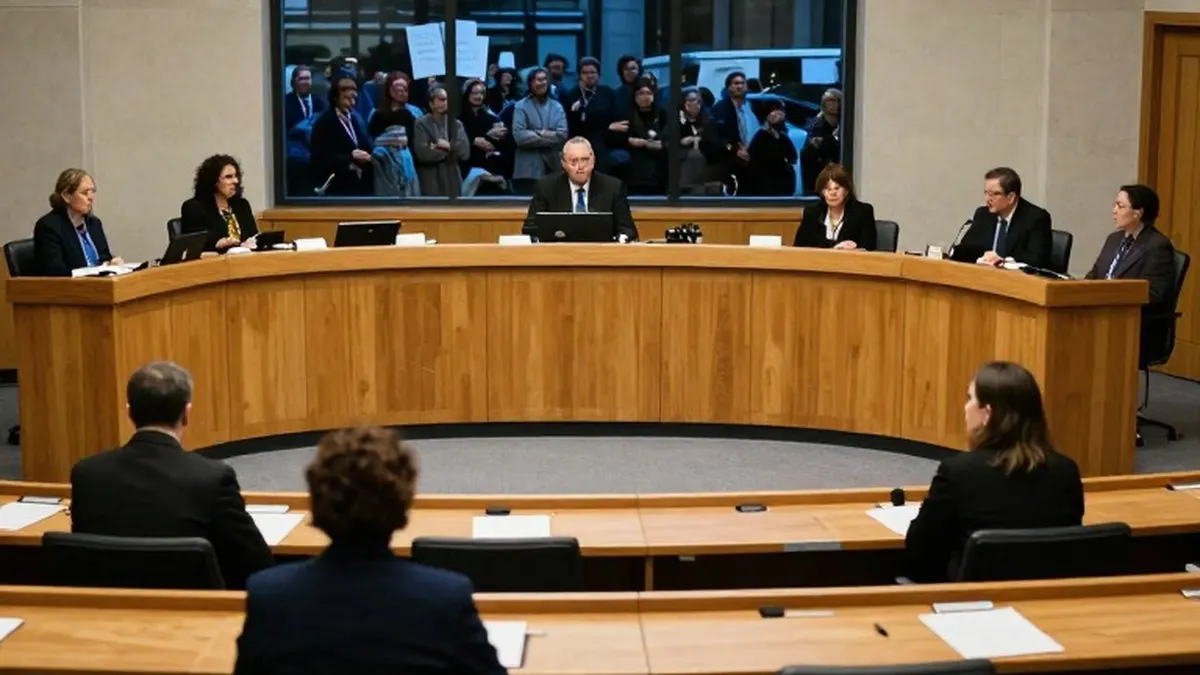
The call for unity followed a significant incident during the swearing-in ceremony of the 26th Knesset on Tuesday. During the singing of the national anthem, Hatikvah, lawmakers from the Joint List faction walked out of the chamber. In contrast, Mansour Abbas, the chairman of the Ra'am faction, and his colleagues remained standing for the duration of the anthem.
Netanyahu stated that a conversation held with Eisenkot on Thursday reinforced his belief that Israel requires a government uniting all parties that acknowledge the state as the nation-state of the Jewish people. The two leaders met for a briefing on security and diplomatic matters that lasted more than two hours. Netanyahu’s military secretary was present at the meeting.
In a video message shared on social media, Netanyahu emphasized the necessity of this coalition. He explained that the meeting with Eisenkot solidified his view that a national unity government is essential. Such a body would include all parties supporting Israel’s identity and would be better equipped to handle the complex security challenges facing the nation.
Addressing Eisenkot directly, the Prime Minister urged him to set aside efforts to build an alternative coalition. He suggested that the current approach risks creating a shaky and dangerous administration that may struggle to meet national needs. Instead, Netanyahu proposed that the two leaders enter negotiations without preconditions, putting aside disagreements and boycotts to reach agreements on key issues, including military conscription for the haredi population.
This appeal occurs while Eisenkot works to assemble a coalition following the October 27 elections. He was tasked with this responsibility by President Isaac Herzog. The two leaders have previously clashed over the concept of national unity. Eisenkot’s party had canceled planned coalition talks with Likud after Netanyahu’s speech at the Tuesday ceremony, citing what they described as divisive rhetoric from the Prime Minister.
Netanyahu also framed the push for a unity government as a response to a renewed existential threat from Iran. He warned that the Iranian regime, which seeks Israel’s destruction, is working to renew its nuclear program. The Prime Minister stated that Tehran would not hesitate to use nuclear weapons once it successfully resumes uranium enrichment and accelerates its weapons development.
He cited recent military operations, including Operation Rising Lion and Operation Roaring Lion, as examples of Israel’s efforts to eliminate this threat. Netanyahu argued that a narrow government or one relying on supporters of terrorism would be ill-equipped to meet this challenge. He contended that only a national unity government could achieve the necessary goals in time to ensure long-term security.
The Prime Minister had raised similar warnings about Iran’s nuclear ambitions during his address to the Knesset on Tuesday. He presented the proposal for a unified government as a solution to address deep divisions within Israeli society. Netanyahu concluded by speaking to the longing for national reconciliation among citizens, asserting that the current moment demands collective action.