Michigan draft order: Five more plants could face sales ban
The state proposes restricting or prohibiting creeping water-primrose, butterbur, and three other species, with public comments due by December 18.
By Renata Mehta ·
Michigan officials are proposing a new list of invasive plants that would restrict how five specific species are bought, sold, and moved across the state.
A draft order introduced Tuesday by the Michigan Invasive Species Program would add creeping water-primrose, large flowered water-primrose, common butterbur, lesser celandine, and round-leaf bittersweet to the state's regulatory list.
If the Commission of Agriculture and Rural Development approves the measure, the first two water-primrose species would be prohibited entirely. That means they could not be introduced, sold, traded, moved, or shared within Michigan boundaries. The other three plants would be restricted rather than banned, allowing for management while preventing new introductions.
Existing plants already in the ground would remain, according to the draft. Katie Grzesiak, the terrestrial invasive species coordinator for the Michigan Department of Natural Resources, explained the strategy. “For the most part, eradication is not a goal in invasive species. When we’re dealing with established species, we’re more likely thinking about ‘how do we reduce the harm?’”
Matthew Bertrand, a park planner for Washtenaw County, voiced support during public comment at the commission meeting. He noted that these are high-threat species. “All those species are high-threat species for which the continued planting in communities likely poses a high financial cost to public agencies in the future and a high cost to nature,” Bertrand said.
The program, which includes experts from the Department of Agriculture and Rural Development, the Department of Environment, Great Lakes, and Energy, and the DNR, selected these plants based on their likelihood of thriving in Michigan and their status in neighboring states.
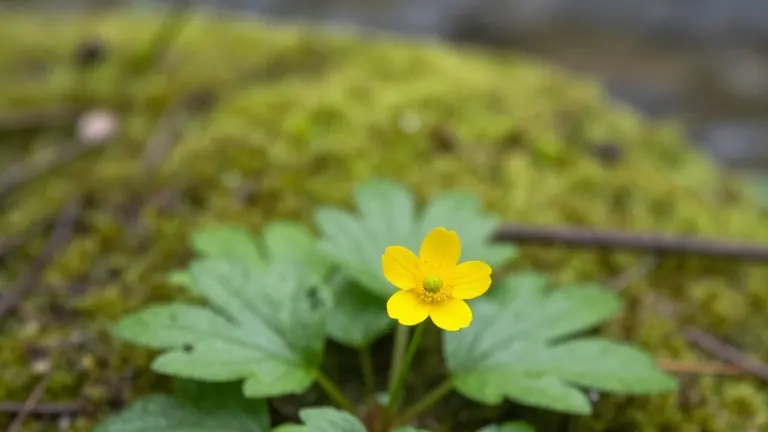
Creeping water-primrose and large flowered water-primrose are floating perennials with yellow flowers. They form mats in waterways that can make paddling difficult and reduce oxygen levels. Creeping water-primrose is currently sold as a water garden plant and has been spotted in the wild in only four counties. Large flowered water-primrose is also sold for gardens but has not yet been confirmed in the wild, requiring genetic identification.
Common butterbur is a tall, broad-leafed perennial native to Europe and Asia. It clogs waterways and is toxic to plant eaters. It is scattered in pockets across the state, particularly in the Upper Peninsula. Lesser celandine is a small spring plant with yellow flowers that forms dense mats and contributes to erosion after it dies back. It is common in the Grand River watershed.
Round-leaf bittersweet is a fast-growing woody vine with red fruit often used in holiday decorations. It outcompetes native vines and disrupts wildlife movement. It is found throughout the Lower Peninsula but is not usually sold in Michigan. The plant is already regulated in about a dozen states, including Wisconsin, Minnesota, Illinois, Indiana, and Pennsylvania.
The public comment period begins Wednesday and runs until December 18. The Michigan Department of Agriculture and Rural Development will post the draft order online by the end of Tuesday. Officials will also present the draft to the Natural Resources Commission, which can offer advice but does not make decisions. In January, experts will return to the Commission of Agriculture and Rural Development with a summary of comments. The commission will then vote on the order. If signed, constraints on prohibited plants take effect one month later. Regulations for restricted plants start in January 2029 to give the plant industry time to adjust.