57 Million Voted Early as Parties Clash Over Turnout Strategy
With polls open, RNC Chairman Joe Gruters and DCCC Chair Suzan DelBene outline opposing views on voter engagement for the 2026 midterms.
By Renata Mehta ·
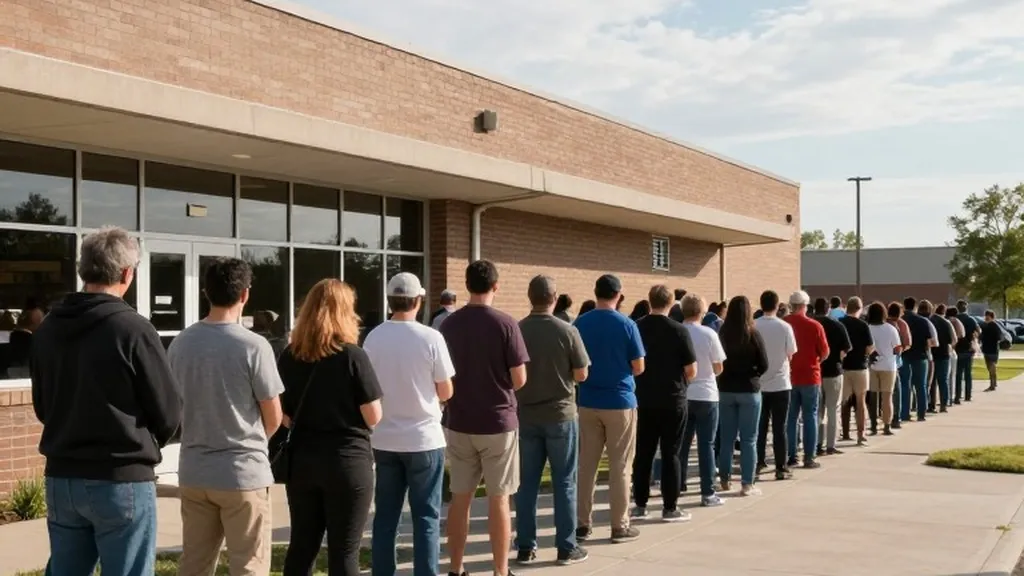
A record 57 million Americans cast their ballots before Election Day, a figure that has already surpassed the early vote totals from the previous cycle in many closely watched states. This surge in early participation sets the stage for a decisive showdown in the U.S. House and Senate, where the outcome will determine who controls Congress during the final two years of President Donald Trump's second term. As polling places open across the country, the focus has shifted from preliminary numbers to the ground game, with both parties emphasizing the critical importance of bringing their base to the polls.
RNC Chairman Joe Gruters has framed the day's strategy around the sheer volume of Republican participation. In a statement released prior to the polls opening, Gruters asserted that everything depends on turnout. He noted that if the party can successfully turn out its voters, they will secure a victory, a goal that has driven the committee's planning efforts for months. This emphasis on mobilization reflects a Republican strategy aimed at holding onto the Senate while bracing for the possibility of losing the House, a common pattern in midterm elections where the president's party often faces seat losses.
In contrast, DCCC Chair Rep. Suzan DelBene highlighted the sentiment driving Democratic voters to the polls. DelBene stated that the American people are angry and that they are seeking change. This narrative aligns with recent polling data from the Associated Press, which indicates that 35 percent of U.S. adults approve of President Trump's job performance, while 25 percent approve of his handling of the economy. The AP also reported that about seven in ten Americans believe the country is heading in the wrong direction, a sentiment that Democratic leaders are leveraging to energize their base on this critical day.
The high early vote count is not just a statistic but a signal of intense engagement in battleground districts. Ballotpedia identifies 46 House districts as battlegrounds, with 25 currently held by Democrats and 21 by Republicans. In the Senate, 13 races are considered competitive, including key matchups in states like Georgia, Michigan, and North Carolina. The Associated Press notes that one or two seats could tip the balance in either chamber, making the ground game in these specific regions paramount. Voters in these areas are weighing economic concerns and border security heavily in their decision-making.
President Trump has been actively campaigning to influence the outcome, holding dozens of rallies in the final stretch. His most recent event took place in Salina, Kansas, where he told supporters that he wanted them to pretend he was on the ballot. His schedule included stops in Mississippi, South Carolina, and Texas, though many Republican candidates maintained a degree of distance from the president's presence. Despite this, Trump's administration has continued to make claims about voting fraud, including assertions that noncitizens vote in large numbers, which has led to legal actions in Alaska and California.
The Associated Press describes the 2026 election as a referendum on Trump's second term, noting that voters are struggling with high prices and are angry over an unpopular war with Iran. This context is shaping the way candidates frame their messages at the polling places today. In Florida, voter Mark Barker of Palm Beach Gardens expressed his support for the president, stating that he has been following Trump the whole time and believes he is doing an awesome job. In North Carolina, James Moore, a 57-year-old librarian in Raleigh, highlighted the economic strain, noting that he is paying more taxes and more for healthcare and everything else.
Money has played a significant role in shaping the campaign landscape, with the 2026 elections likely becoming the most expensive in history. Republican committees outraised and outspent their Democratic counterparts, aided by Trump-affiliated groups and Elon Musk. However, at the candidate level, Democrats managed to outraise their opponents. An analysis of AdImpact data by the Associated Press shows that 88.1 percent of Republican general election TV ad spending went to states and districts that Trump won in 2024. This targeted approach suggests a strategy to consolidate support in areas where the president has a strong base of approval.
As voters head to the polls today, the logistics of the election are also a point of focus. The U.S. Postal Service added hours, staff, and special lines to ensure that mail ballots are counted on time. A federal judge temporarily barred the Trump administration from carrying out a plan intended to prevent noncitizen voting, a move that critics said risked disenfranchising eligible voters. In California, a judge ordered the administration to stop demanding that election officials segregate ballots cast by people on lists of suspected noncitizens. These administrative details are crucial for ensuring that the 57 million early votes and today's in-person ballots are processed efficiently.
The stakes for the House are particularly high, as Democrats need a net gain of three districts to take the majority, while Republicans can lose no more than two. In the Senate, Democrats need a net gain of four seats, and Republicans can lose only two. The governor's races are also critical, with Democrats hoping to hold a majority of governorships for the first time in two decades. The Associated Press notes that if Democrats win even one chamber, investigations and possible impeachment proceedings become likely. House Democratic Leader Hakeem Jeffries has outlined a 100-day agenda focused on the cost of living and oversight, signaling the potential direction of a Democratic-led House.