House Fight Hinges on 46 Districts and New Maps
With polls open, the three-seat margin separating control of the House has turned every battleground district into a decisive contest for both parties.
By Renata Mehta ·
The control of the U.S. House of Representatives is the central question of the day as voters head to the polls across all 435 districts. Republicans currently hold 218 seats, Democrats hold 214, and one seat is held by an independent. This configuration creates a razor-thin margin where Democrats need a net gain of three districts to claim a majority, while Republicans can afford to lose no more than two seats. The Associated Press notes that the election is being viewed as a referendum on President Donald Trump's second term, with many voters citing high prices and an unpopular war with Iran as primary motivators.
Ballotpedia has identified 46 battleground districts that could determine the final tally. Of these, 25 are currently held by Democrats and 21 by Republicans. The geographic distribution of these competitive races is heavily influenced by the new congressional maps implemented in seven states: California, Florida, Missouri, North Carolina, Tennessee, Texas, and Ohio. These redistricting changes have reshaped the political landscape, creating new competitive dynamics in regions that were previously considered solid for one party or the other.
The stakes for Republican leadership are high as they attempt to maintain their majority in the chamber. Republican National Committee Chairman Joe Gruters emphasized that everything depends on turnout, stating that if they turn out their voters, they win. This strategy reflects a broader Republican focus on mobilizing the base, particularly in districts where the 2024 presidential results favor President Trump. However, the party faces a significant challenge in 21 Democratic-held districts that voted for Trump in 2024, suggesting that the House race may not align perfectly with the presidential leanings of those areas.
Conversely, Democrats are focused on flipping key districts to secure the three seats needed for control. The Democratic Congressional Campaign Committee Chair, Rep. Suzan DelBene, described the American people as angry and desiring change. This sentiment is supported by polling data from the Associated Press and NORC, which shows that about seven in 10 U.S. adults believe the country is heading in the wrong direction. Most of these voters blame President Trump for high prices, a theme that has dominated Democratic messaging in the 46 battleground districts.
The new maps in the seven redistricted states have created a complex environment for candidates. In Florida, for example, the new districts may not vote as drawn, according to the Associated Press, adding a layer of uncertainty to the race. Similarly, in Texas and California, the shifts in district boundaries have altered the electoral calculus, making more races competitive than in previous cycles. These changes are critical because the House majority will determine the legislative agenda for the final two years of President Trump's term, including potential investigations and oversight functions.
Voter behavior in these districts is closely tied to economic conditions. A voter in Raleigh, North Carolina, noted that they are paying more taxes, more for healthcare, and more for everything. This economic strain is a central theme in the AP's coverage, which describes the election as a response to high prices. The AP-NORC poll indicates that only 25 percent of U.S. adults approve of the president's handling of the economy, a figure that likely impacts the 46 battleground districts where economic concerns are most pronounced.
The administration has also been active in ensuring the integrity of the vote, though this has led to some legal disputes. A federal judge temporarily barred the Trump administration from carrying out a plan to prevent noncitizen voting, while another judge ordered the administration to stop demanding that California officials segregate ballots cast by people on lists of suspected noncitizens. These legal moves are part of a broader strategy to address concerns about voting fraud, including claims that noncitizens vote in large numbers. Critics argue that these actions risk disenfranchising eligible voters and infringing on state authority.
The financial aspect of the campaign has also played a role in shaping the race. The 2026 elections are likely to be the most expensive in history, with Republican committees outraising and outspending Democratic committees at the national level. This spending is heavily concentrated in states and districts that Trump won in 2024, with 88.1 percent of Republican general election TV ad spending going to those areas. This strategy reflects an effort to protect the party's base in safe seats and consolidate support in competitive districts.
As polls open, the focus remains on the 46 battleground districts and the three-seat margin that separates control of the House. The results in these districts will determine whether Democrats can achieve their goal of a net gain of three seats or if Republicans can hold onto their majority. The new maps in seven states have added a new variable to this calculation, making the outcome of the House race particularly uncertain. Voters in these districts are making decisions based on a mix of economic concerns, presidential performance, and local issues.
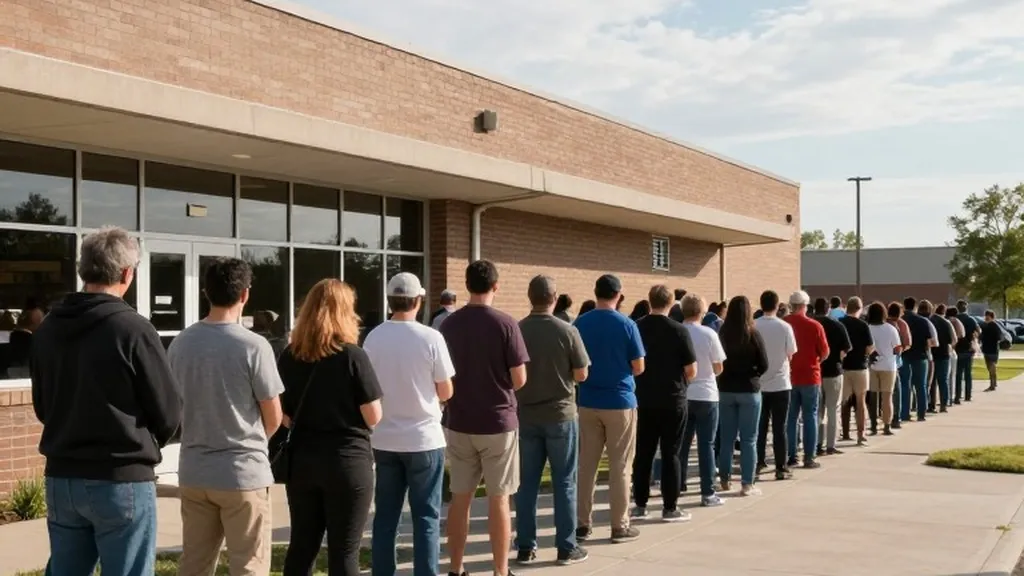
The Associated Press reports that more than 57 million people had already voted as of Monday, surpassing the early vote of four years ago in many closely watched states. This high level of early participation suggests that the final outcome in the 46 battleground districts may be determined by the last-minute turnout on Election Day. The race for the House is not just about the total number of seats but about the specific dynamics in these competitive districts, where the new maps and voter sentiment are creating a highly contested environment.