Islanders face a choice between familiar leadership and a shift in power
With polls showing a near-tie in Israel's parliament, voter turnout and military service rules for religious groups may determine the outcome of Tuesday's election.
By Renata Mehta ·
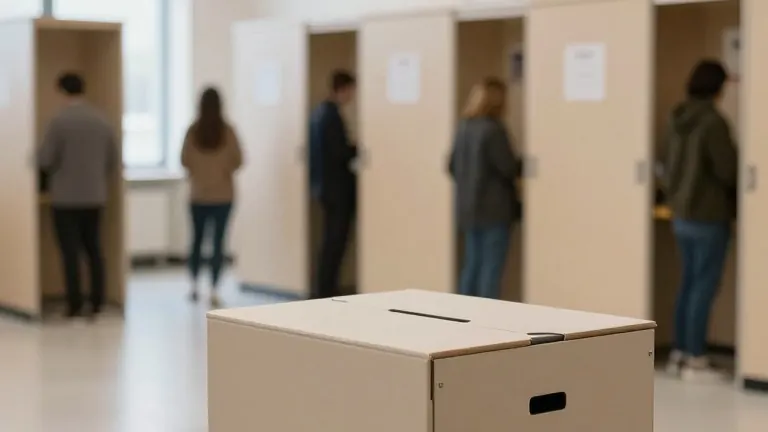
Israeli voters head to the polls on Tuesday in a contested election that may leave Prime Minister Benjamin Netanyahu without a clear mandate. Three years after the October 7, 2023, Hamas attacks, the nation remains engaged in conflicts in Gaza, Lebanon, and Syria. Most recent polls indicate that neither the right-wing bloc led by Netanyahu nor the opposition change bloc is likely to secure a majority of the 120 seats in the Knesset.
The close race has prompted experts to predict a potential stalemate. Yohanan Plesner, president of the Israel Democracy Institute, noted that an indecisive outcome is the most likely scenario. This could result in lengthy coalition negotiations, a minority government, or a repeat election. Netanyahu's camp argues that only he can form a government without relying on Arab parties, which he views as a risk during wartime.
Netanyahu also contends that his government needs more time to complete military operations against Iran, a threat he describes as existential. President Donald Trump offered his support for Netanyahu last week, warning that the United States might have to handle the Iran threat alone if a different leader takes power. Trump stated, “If Israel has the wrong Leader, which would be anyone other than Bibi, America will have to do this work ourselves, and I am not inclined to do so.” Netanyahu’s campaign slogan plays on this fear, suggesting voters must choose between the right wing and a nuclear bomb.
Opposing Netanyahu is a diverse group of parties united by their desire to replace the current government. The leading candidate in this change bloc is Gadi Eisenkot, a former military chief of staff who leads the centrist Yashar party. Eisenkot lost his son and two nephews in the Gaza war and served in the war cabinet for much of its first year. His party features a gender-balanced candidate list, with about half being women, a sharp contrast to the male-dominated Netanyahu coalition.
Eisenkot has criticized Netanyahu for using fear-mongering tactics, including the recent posting of an AI-generated image of a nuclear explosion over Tel Aviv. Eisenkot promised to launch a state inquiry into the intelligence failures that allowed the October 7 attacks, a step Netanyahu has blocked. Uzi Aharoni, a 73-year-old engineer from Tel Aviv, described Eisenkot as a straight and honest leader who would prioritize the people over his own family.
Voter turnout among Arab Israelis and ultra-Orthodox communities could tip the balance. Arab citizens make up about 20% of the population, and higher turnout among this group makes it harder for Netanyahu to build a traditional right-wing coalition. Jehad Abomoch, a cafe owner in the Arab city of Baqa al Gharbiya, said many in his community see the last four years as a catastrophe. “The last four years were a real catastrophe, both socially and in terms of wars,” Abomoch said.
Two new parties focused on conscripting ultra-Orthodox men for military service are also entering the race. Polls show both are hovering near the threshold needed to win Knesset seats. Success for either party could challenge Netanyahu’s alliance with religious partners. If neither bloc wins a majority, parties might switch sides or form a minority government with the support or abstention of Arab parties. If negotiations fail, Israel will hold new elections, a scenario that occurred five times between 2019 and 2022.
Source: CBS News