Swift telescope set to burn up over Earth after failed rescue
The 22-year-old observatory is expected to re-enter the atmosphere this Friday, with debris potentially falling across multiple continents.
By Grace Almasi ·
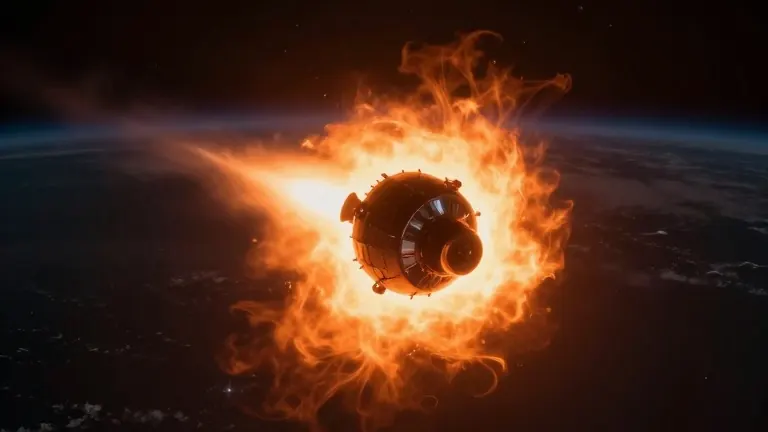
The Swift Observatory is predicted to crash back to Earth on or around Friday. The U.S. Space Force is tracking the 1.5-ton telescope as it descends from orbit. Most of the spacecraft will disintegrate in the atmosphere.
NASA chief scientist Brad Cenko stated that several components may survive the re-entry. These fragments include mirror parts and pieces made of tungsten, a metal denser than lead. Surviving debris is most likely to land in the ocean. However, the re-entry zone covers wide areas of Africa, Australia, India, Southeast Asia, and Central and South America.
The Swift team views the end of the mission with mixed emotions. John Nousek, an astronomer at Pennsylvania State University who led the control team, said the team knew this day would arrive before launch. He described the end as catastrophic but noted that what goes up in low-Earth orbit must eventually come down. Nousek expressed gratitude for the data collected during the 22 years the telescope spent in space.
Swift launched on November 20, 2004, to detect gamma ray bursts and supernovas. Intense solar activity in recent years pushed the telescope into a lower orbit faster than planned. In response, NASA hired Katalyst Space a year ago to attempt a rescue. The company sent a three-armed robot named Link in July. The robot failed to dock and stopped at a distance of 12 to 15 kilometers from Swift. Link fell back to Earth in September.
Swift resumed scientific work after the rescue attempt was abandoned. It continued to detect high-energy events until late October. By that time, the telescope was too low in orbit to maintain stability for observations. Engineers shut down its systems to prepare for re-entry.
The mission recorded more than 2,000 gamma ray bursts and 1,400 exploding stars. It also identified comets, asteroids, and black holes. Swift served as a first responder for other observatories, such as Hubble and Webb, by alerting them to follow up on alerts. The telescope could swivel quickly toward new events, a capability that defined its role in astronomy.
Nousek said in an email that the team hopes lessons from Swift will apply to future missions. He stated the goal is to accelerate discoveries about the universe. The final orbit has ended, and the spacecraft is now falling toward the planet.
Source: CBC News